

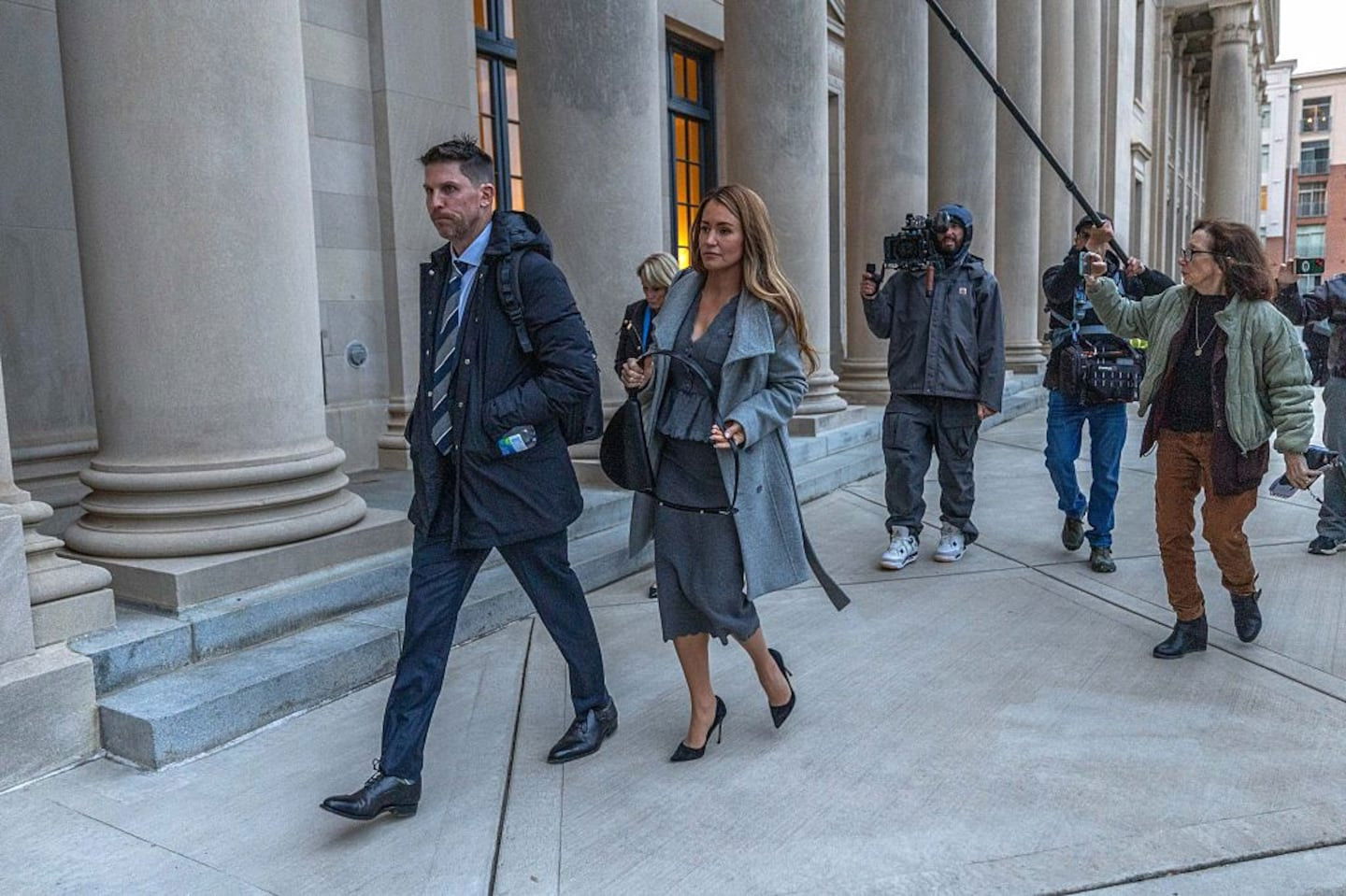
CHARLOTTE, N.C. — Denny Hamlin’s second day on the witness stand turned into one of the most heated moments yet in the antitrust trial between 23XI Racing and NASCAR, producing hours of tense exchanges and raw emotion.
Hamlin fired at NASCAR, and NASCAR shot right back.
What began Monday with Hamlin’s calm recounting of his career and his father’s declining health erupted Tuesday into a fierce back-and-forth between one of NASCAR’s biggest stars and NASCAR’s external counsel, Lawrence Buterman, as the league attempted to dismantle Hamlin’s claims of monopolistic control over the sport.
Hamlin spent roughly four hours testifying over the two days, with 3.5 of those coming Tuesday morning. By the time he stepped down, he had sparred repeatedly with Buterman, accused NASCAR of twisting his words, and openly displayed what he described as years of pent-up frustration over the sport’s business structure.
At times, Hamlin raised his voice, cut off questions and challenged entire premises of NASCAR’s arguments, leaving an uncertain impression of how the jury might interpret his confrontational approach.
Much of the cross-examination centered on whether Hamlin had been consistent in his public statements about NASCAR.
Secure your spot today.
Buterman walked him through interviews, podcasts and internal pitch materials from before 23XI Racing was founded, including the deck Hamlin used to persuade Michael Jordan to invest. That presentation praised the charter model, touted Bubba Wallace’s marketability and described the sport as primed for growth.
Buterman argued that those materials contradict 23XI’s claim that NASCAR’s system is anticompetitive and financially suffocating for teams.
Hamlin countered that his public comments were often influenced by NASCAR expectations, saying he was “painting a rosy picture” and following what the league wanted its drivers to say.
Any positive statements, Hamlin insisted, were either taken out of context or made under the assumption NASCAR would deliver on promises, particularly that the Next Gen car would reduce team costs by 40 percent, something Hamlin said never materialized.
“Documents don’t lie,” he repeated multiple times.
Buterman pressed him on issues ranging from 23XI’s financial health to Hamlin’s own salary—$14 million annually from Joe Gibbs Racing. That is more than Aaron Rodgers will be making in 2025, and equal to what NFL MVP candidate Jonathan Taylor will be making this year.
Hamlin had also made an earlier request that Jordan consider finding someone to buy him out.
NASCAR argued that move undermines Hamlin’s portrayal of himself as committed long-term. Hamlin brushed it off as frustration from feeling unheard by his partners, saying he was “kicking and screaming for attention” to steer the team in the direction he believed it needed to go.
The cross also dug into exclusivity clauses, with NASCAR pointing out that 23XI restricts drivers like Riley Herbst from racing elsewhere, mirroring what Hamlin criticizes NASCAR for in the lawsuit.
Hamlin responded sharply.
“We aren’t a monopoly. You are.”
He argued that drivers have alternative teams to sign with, whereas teams do not have alternate sanctioning bodies or financial models.
The line became a repeated refrain throughout the morning.
”NASCAR is a monopoly.”
Buterman underscored that NASCAR pays teams a higher percentage of its revenue than 23XI pays its drivers. Hamlin retorted that teams carry the downside risk of rising costs, while NASCAR dictates spending through spec parts and required suppliers.
“You force us to buy all the cars, the components … we don’t own any of that,” Hamlin said. “How ridiculous is that?”
At one point, the questioning turned to the seven-year charter agreement NASCAR offered teams, with a second optional seven-year term at a flat rate. Buterman characterized it as a concession toward teams’ desire for long-term stability.
Hamlin rejected that outright, saying the lack of revenue percentage tied to the next media deal amounted to a dead end.
“This is essentially my team’s death certificate,” he testified.
He added that 23XI wanted to “ride the highs and lows” with NASCAR and Jim France, not be locked into a fixed number regardless of future growth.
When Buterman noted NASCAR guaranteed teams would receive no less than current-period earnings, Hamlin responded sarcastically: “Well, thank you. I appreciate that.”
Hamlin described other points of contention with equal intensity, including the cost of required international races such as Mexico City, which he argued are imposed expenses with no team veto mechanism.
“They could send us to Dubai.” Hamlin said, somewhat jokingly.
He mocked NASCAR’s team owner councils as “committees with no power” created only when the league feels threatened. And he criticized the Driver Ambassador Program (DAP), saying it forces teams to hand over their greatest assets—the drivers—for NASCAR’s marketing use while requiring teams to pay 40 percent of the program’s funding.
When Buterman asked whether drivers should be paid for such obligations, Hamlin dismissed the notion: “Teams pay drivers, not NASCAR.”
Jordan and 23XI co-owner Curtis Polk sat in the front row throughout the proceedings, frequently smiling or shaking their heads in reaction to Hamlin’s barbed responses.
Jordan appeared had mixed emotions as Hamlin fired back at attempts to characterize him as an inconsistent narrator of his own business dealings.
Hamlin acknowledged disagreements with Jordan’s CFO Gene Mason and Polk, who had called him a “terrible businessman” in internal messages, but said such clashes were normal and always resolved.
“Me and Michael, we want to win,” Hamlin said.
Meanwhile, NASCAR executives also took the stand.
Scott Prime faced questioning from 23XI attorney Jeffrey Kessler over NASCAR’s early charter negotiation strategies, including internal reactions to the rise of LIV Golf and the teams’ early demands.
Prime insisted NASCAR’s contingency planning in case teams refused to sign the charter agreement was not a definitive blueprint for replacing teams but merely preparation for any scenario.
All of this followed Monday’s opening day in which Hamlin became emotional discussing his father’s health and described the long arc of his racing career.
The first day also featured opening statements from both sides. Kessler outlining the alleged monopoly and NASCAR attorney John Stephenson arguing the dispute amounted to a failed contract negotiation, not antitrust misconduct.
At the center of it all is the financial relationship between NASCAR and its teams.
Hamlin testified that 23XI’s profit margin is just 2.26 percent, and fragile enough that losing a single sponsor could erase it entirely.
Teams, he said, operate on thin margins while NASCAR and the France family retain control and reap the biggest rewards.
Hamlin reiterated that only one side of the sport is at risk of going out of business, pointing to the long list of shuttered teams since the charter system began.
The teams seek $205 million in damages, a number Buterman noted would deliver a massive return on 23XI’s investment.
”We put on your show every week—we should have our costs covered.” Hamlin argued.
Hamlin avoided elaborating, saying financial experts would address the valuation, and simply stated: “We want to be made whole for what you guys did to us.”
The trial is expected to stretch at least another eight business days and will feature testimony from additional high-profile figures, including Jordan and Polk.
After Tuesday’s explosive exchanges and with both sides digging deeper into years of financial disputes and public-versus-private narratives, the stakes continue to rise—not just for the lawsuit, but for the future structure of the sport itself.













Discussion about this post